

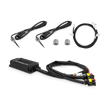
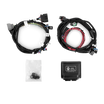

Getting a modified engine to idle smoothly, cruise without surging, and pull hard at wide-open throttle used to mean swapping carburetor jets on the side of the road with a burnt forearm. You tuned for the weather that day, and if you drove into the mountains, your carefully dialed-in setup instantly ran rich. Today, "self-learning" EFI systems handle the heavy lifting, adjusting to altitude, temperature, and engine load on the fly.
But past the marketing jargon, what is a standalone ECU actually doing when it claims to learn? It comes down to processing speed, sensor data, and dynamic fuel mapping.
The Mechanics of Fuel Mapping
Fuel injection relies on two primary data tables: Volumetric Efficiency (VE) and Target Air/Fuel Ratio (AFR).
Think of your engine as an air pump. The VE table dictates exactly how efficiently that pump moves air at any specific RPM and manifold pressure (engine load). No two custom engines flow air identically. A mild 350 small block has a vastly different VE profile than a 6.0L LS with a high-lift camshaft and ported heads.
The Target AFR table sets the exact air-to-fuel ratio you want the engine to run under those same conditions. You might target a lean 14.7:1 for highway cruising to save gas, but demand a rich 12.5:1 at wide-open throttle to make maximum horsepower and keep the cylinders cool.
Historically, tuning meant manually adjusting every single cell in the VE table on a laptop so the engine's actual AFR matched the target. Self-learning systems help to automate this. They read the exhaust gases and rewrite the VE table in real-time while you drive.
The Wideband O2 Sensor Loop
This automated mapping requires a hyper-fast feedback loop, handled by a wideband oxygen sensor like those included in every Aces kit. Older narrowband sensors only knew if an engine was running rich or lean—a simple "yes or no" signal. A wideband reads the exact numerical mixture.
When the engine reaches operating temperature, the system enters Closed-Loop operation. The ECU constantly compares the actual AFR from the wideband against your programmed Target AFR. If you target 13.5:1 but the sensor reads 14.2:1 (too lean), the computer instantly calculates the difference and increases the fuel injector pulse width to compensate.
Short-Term vs. Long-Term Fuel Trims
To understand self-learning, you have to separate immediate corrections from permanent learned data.
When the ECU makes a split-second adjustment based on the wideband sensor, it generates a Short-Term Fuel Trim (STFT). This keeps the engine running well in the moment. However, if the ECU notices it is constantly adding 5% more fuel at a specific RPM and throttle position, it transfers that data to the Long-Term Fuel Trim (LTFT).
The LTFT permanently alters the base VE map. This is the actual "learning" process. The more miles you log under different driving conditions—stop-and-go traffic, highway cruising, hard acceleration—the more precise the base map gets. Eventually, the ECU barely relies on the short-term corrections because the base map has been perfectly customized to your engine's airflow.
Why 32-Bit Processing?
The physical hardware dictates how well this self-learning software performs on the street. At 6,000 RPM, an engine completes 100 revolutions every single second. The ECU has fractions of a millisecond to read the sensors, calculate the target, determine the required fuel, and fire the injector.
Early aftermarket EFI systems relied on 8-bit or 16-bit processors. They worked, but often lacked the bandwidth to process fuel, spark, and sensor inputs simultaneously without lagging, which translated to throttle hesitation or a wandering idle.
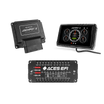
Modern setups, like the Aces EFI Automotive-grade 32-bit ECU, process millions of calculations exponentially faster. This jump in computing power allows the ECU to:
- Sample data continuously: The ECU monitors manifold pressure, throttle position, coolant temperature, and exhaust gases without bottlenecks.
- Execute micro-adjustments: A 32-bit processor calculates fuel trim adjustments and physically changes the injector pulse width between individual engine strokes.
- Manage advanced features: Beyond fueling, it has the overhead to simultaneously manage electronic spark control, dual electric cooling fans, and fuel pump triggers without slowing down the core self-learning algorithm.
Do You Still Need a Dyno Tune?
For most street-driven restomods, a high-quality self-learning EFI system easily manages drivability, cruising fuel economy, and elevation changes. The ECU will map out the fueling for an LS swap, a Hemi, or a traditional small block with a mild cam without ever strapping the car to a chassis dyno.
However, self-learning focuses primarily on fuel delivery. Dialing in a custom ignition timing curve for maximum power, or tuning a forced induction setup (turbos or blowers), still requires manual laptop adjustments. The advantage of a 32-bit system is flexibility. You can let the ECU learn the street manners and daily drivability automatically, then hook up a laptop using the pro-level software to dial in the high-performance parameters later.
Swapping to standalone EFI integrates modern computing into older hardware. By pairing ultra-fast 32-bit hardware with wideband sensor feedback, the system adapts to your specific engine's mechanical characteristics on the fly. You get the turn-key reliability and crisp throttle response of a late-model car, without losing the raw mechanical character of a custom build.
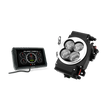
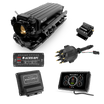
Ready to update your engine bay? Check out the 32-bit processing power behind the Aces EFI Jackpot and Killshot systems.


Leave a comment
This site is protected by hCaptcha and the hCaptcha Privacy Policy and Terms of Service apply.