

What’s the Difference and Which One Is Right for Your Build?
As our lineup has expanded, the Gen 1 vs Gen 2 question comes up constantly. Builders want to know what actually changed, what it means for their combination, and whether Gen 1 is still a smart choice.
Here’s the honest answer.
Gen 1 is a proven standalone EFI platform that runs the majority of street builds extremely well. It is stable, predictable, and capable.
Gen 2 is the next evolution of our hardware architecture. It increases table resolution, expands processing capability, improves signal handling, and opens the door for additional integrated features.
Both are real standalone engine management systems. The difference is not good versus better. The difference is refinement level, expansion capability, and long-term scalability.
Let’s go deeper.
Current Product Breakdown
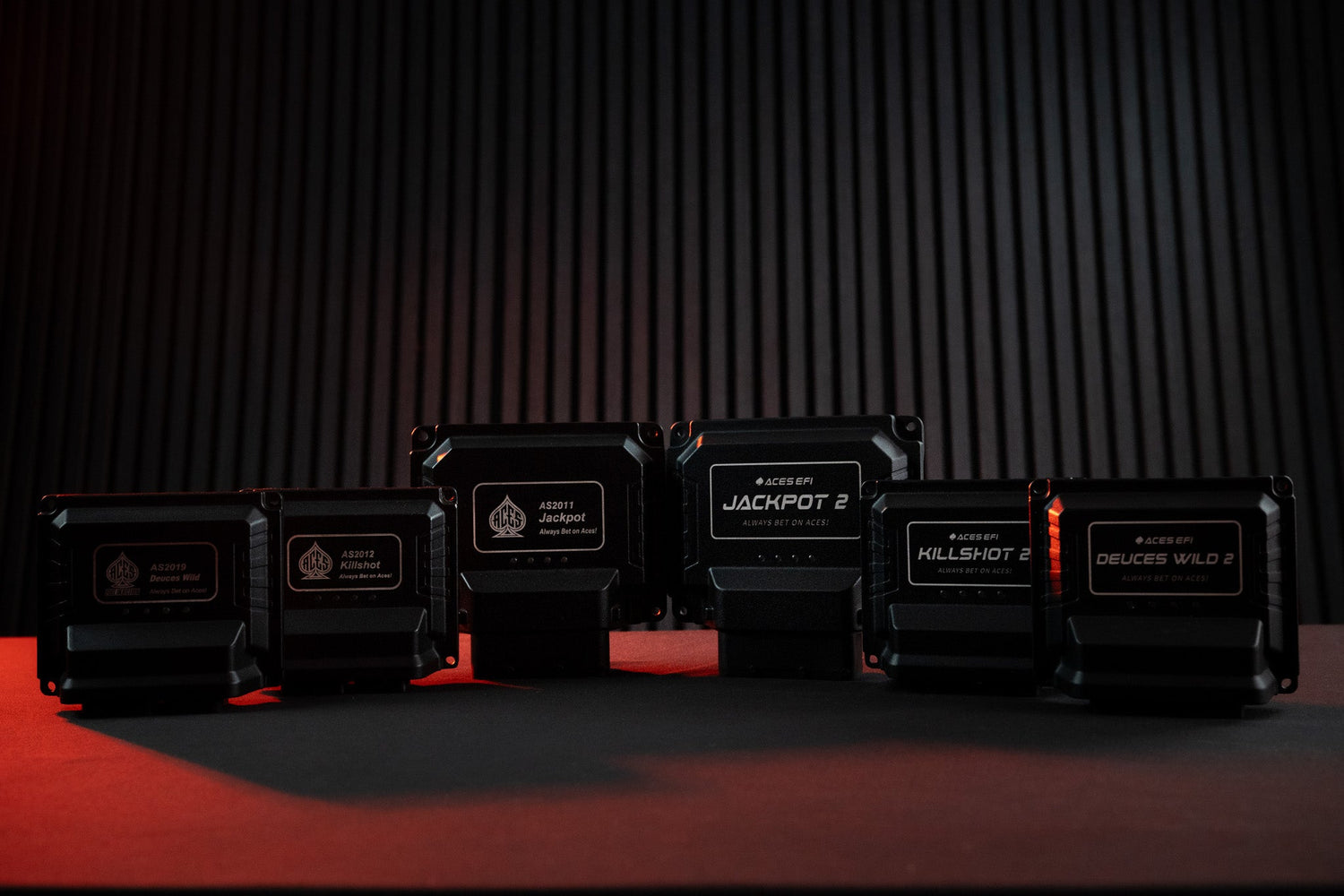
Gen 2 Systems (As of 02/25/2026)
- Killshot 2 Pro
- Jackpot 2 LS
- Jackpot 2 Hemi
- Jackpot 2 LS (TBI)
- Wild Card 2
- Deuces Wild 2
Coming soon:
- Joker 2
- Royal Flush 2
These systems run on our updated 32-bit ECU platform with expanded memory, higher-resolution mapping, and additional hardware capability built into the board design.
Gen 1 Systems (Still Active and Supported)
- Killshot
- Killshot 2
- Killshot Fusion
- Killshot Fusion (Lite)
- Wild Card
- Deuces Wild
- The Joker
- Royal Flush
- Jackpot LS
- Jackpot Hemi
- Jackpot LS (TBI)
- Jackpot LS (Lite)
Gen 1 is not discontinued or unsupported. It remains in production across multiple platforms and continues to power thousands of real-world builds.
Hardware Architecture Differences
Memory and Processing Capacity
Gen 1 was built around a solid 32-bit architecture designed to provide stable RPM control, reliable input and output handling, and consistent operation across varying voltage conditions.
Its calibration structure uses:
- 10×14 fuel tables
- 10×14 ignition tables
- 10×14 self-learning tables
That structure keeps tuning straightforward and manageable, especially for stock to moderate street builds.
Gen 2 expands on that architecture with:
- Larger memory capacity
- 31×31 fuel tables
- 31×31 ignition tables
- 31×31 self-learning tables
- Expanded internal timer functionality
- Improved interrupt handling
The additional memory is not just about table size. It allows the ECU to run more complex algorithms, manage more data simultaneously, and maintain responsiveness under higher load and RPM conditions.

Table Resolution and What It Actually Means
This is the biggest functional change between generations.
Gen 1 uses a 10×14 grid structure. That gives you 140 cells per table.
Gen 2 uses a 31×31 grid structure. That gives you 961 cells per table.
That is not a small jump. It is a major increase in resolution.
In practical terms, more cells mean:
- More precise load and RPM breakpoints
- Smoother throttle transitions
- Finer ignition control under changing load
- Better drivability in part-throttle cruise
- More detailed shaping for aggressive cams
- Improved refinement in boosted applications
For a mild naturally aspirated street build, the difference may not feel dramatic.
For a cammed engine with steep airflow changes, or a boosted engine where load ramps quickly, the additional resolution gives the tuner more control and more stability.
Sensor Signal Processing Improvements
Gen 2 improves how analog sensor data is captured and processed.
Gen 1 uses standard ADC sampling.
Gen 2 adds DMA-based ADC acquisition. This allows more efficient and consistent sensor data handling.
In real-world swaps where grounding quality, alternator noise, and wiring routing vary, this matters. Cleaner data means more stable fueling and ignition control.
Interrupt Handling and Timing Precision
Gen 2 also strengthens internal interrupt handling and expands timer functions.
This improves precision for:
- Injector pulse control
- Ignition timing events
- RPM-based limiters
- Launch control
- Load-based transitions
Under rapid throttle movement or sudden load change, Gen 2 can respond more precisely because it manages external events more efficiently.
Self-Learning Strategy Differences
Gen 1 uses a 10×14 learning table.
Gen 2 uses a 31×31 learning table.
On select Gen 2 platforms such as Wild Card 2, Joker 2, and Jackpot 2 series, dual-bank learning is supported when dual widebands are present.
This matters when:
- Exhaust flow differs bank to bank
- Injector variance exists
- Cylinder balance is not perfectly symmetrical
The higher-resolution learning structure allows for finer correction as the engine operates across its range.
Feature-Level Differences

Fuel Level Input
Gen 1 does not include onboard fuel level input.
Gen 2 includes a dedicated fuel level input that can be viewed through the handheld or mobile app. This is especially helpful on swaps where the factory ECU is removed and the original fuel signal is no longer available to the cluster.
Boost Control Hardware
Gen 1 systems are boost compatible but require a standalone boost controller.
Gen 2 systems include hardware preparation for boost solenoid control. Boost pressure acquisition hardware is onboard where applicable, and software activation is supported on applicable platforms.
Both systems can safely run boosted engines when tuned correctly. The difference is whether boost control is integrated into the ECU hardware itself.
Custom Outputs on Jackpot Gen 2
Gen 2 Jackpot systems include additional hardware preparation for:
- Custom relay control
- Custom ground trigger outputs
Gen 1 does not include this expansion hardware.
Real-World Driving Comparison
Mild Street Build
Stock cam, intake, headers, pump gas
Gen 1 delivers:
- Stable idle
- Strong self-learning capability
- Excellent cruise drivability
- Full standalone spark and fuel control
Gen 2 adds refinement and headroom, but Gen 1 already performs extremely well in this category.
Cammed or Boosted Combination
Gen 1:
- Fully capable when manually tuned
- Requires standalone boost control hardware
- Lower table resolution for ultra-fine shaping
Gen 2:
- Significantly higher mapping resolution
- More precise timing control
- Integrated boost control hardware foundation
- Greater scalability as power increases
This is where Gen 2 provides noticeable advantages, especially for tuners chasing fine drivability and power optimization.
Is Gen 1 Going Away?
No. For now, Gen 1 remains supported, serviced, and maintained.
As new generations are released, older generations may eventually transition out of active production. That is normal for hardware-based platforms.
However, support does not disappear.
Our commitment includes:
- Continued technical support for Gen 1 systems
- Availability of service components and replacement parts
- Ongoing documentation access
- Software compatibility, where applicable
If you own a Gen 1 system, it remains a fully supported standalone ECU platform.
How to Choose
Choose Gen 1 if:
- Your build is stock or mild
- You want proven simplicity
- You are budget-conscious
- You are not chasing extreme horsepower
Choose Gen 2 if:
- You are running aggressive cam profiles
- You are boosted or plan to be
- You want maximum mapping resolution
- You want integrated boost control hardware
- You value long-term expansion capability
Final Thoughts
Gen 1 made standalone EFI more accessible and reliable for real builders.
Gen 2 expands that foundation with higher resolution, stronger hardware capability, and more room to grow.
Both platforms are legitimate standalone engine management systems.
The right choice depends on your combination, your goals, and how far you plan to push your build.
That is the real difference.


Leave a comment
This site is protected by hCaptcha and the hCaptcha Privacy Policy and Terms of Service apply.