
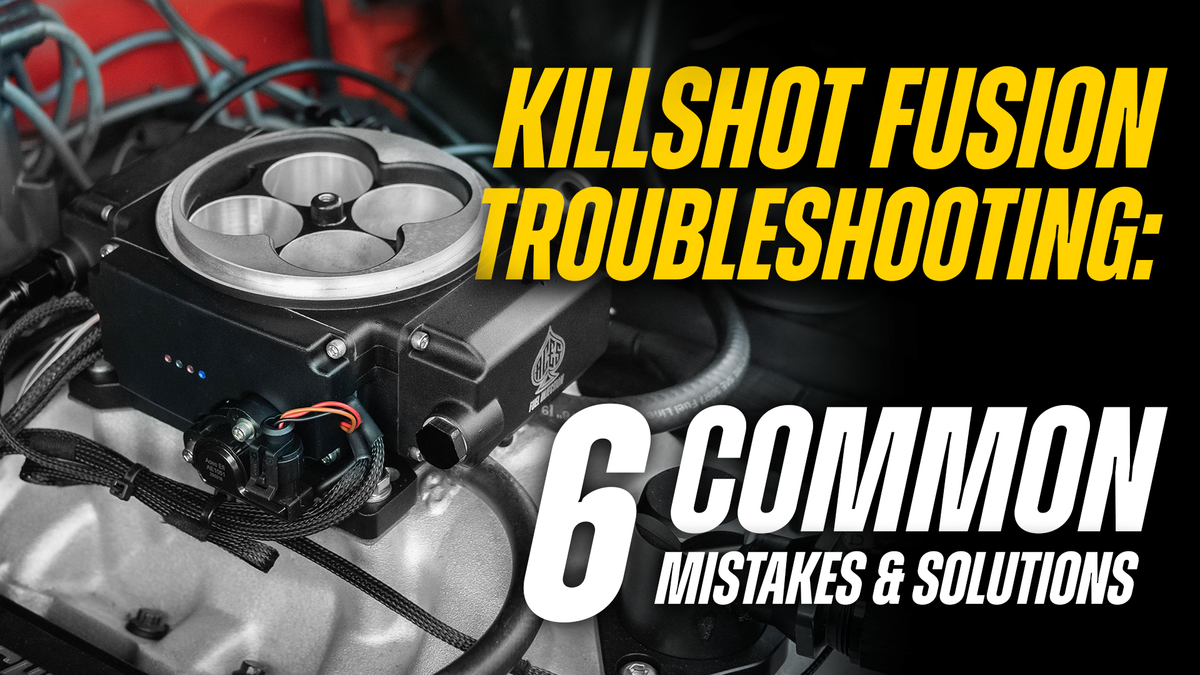
Getting a new EFI system dialed in should be an exciting upgrade, but if your Aces Killshot Fusion isn't firing up right away, it’s easy to get frustrated. Before you start chasing wires and blaming the ECU, take a step back. We see a lot of the same initial setup hiccups in the shop. Here are the six most common things to double-check to get your system running smoothly.
Quick tip: if you want to watch this helpful tutorial as a video, click here!
1. System Selection
One of the most frequent culprits is actually the easiest to overlook: leaving the system selected as a standard "Killshot" instead of the "Killshot Fusion" on your handheld. If you’ve selected the wrong system by mistake, nothing will work right. Jump into the system select screen on your monitor, tap the Killshot Fusion option, and that particular problem will solve itself.
2. Distributor Trigger Settings
Engine timing is everything. There are multiple types of distributor triggers compatible with the Fusion and offered by Aces, and the system calibrates them all differently. When you proceed through the setup wizard, pay close attention to the trigger setting. You absolutely must make sure you have the correct trigger selected for your specific distributor style.
3. Injector Size Calibration
Your ECU calculates fueling based on the parameters you feed it, which means an incorrect injector size selected in the wizard will completely throw off how the vehicle runs. If you are running one of our standard Killshot Fusions, you need to set the flow rate to 100.53 lb/hr. If you are using a Killshot Fusion Lite system, you'll need to select the 65 lb/hr injector option. Getting this right ensures your vehicle runs like it's supposed to.
4. Battery Polarity
It happens to the best of us: hooking the battery cables up backwards in a rush. Unfortunately, there is not much you can do yourself to fix this one. If you've hooked it up backwards, you are most likely going to get a single red light on the unit. At that point, give our customer service team a call at +1 (423) 590-2237, M-F 9:00-5:00 Eastern Time, or shoot us a message right here on AcesEFI.com, and we'll be more than glad to troubleshoot and repair it for you.
5. Ignition Switch Sourcing
Your EFI system demands reliable voltage. Your ignition switch source needs to maintain a solid 12 volts during both the crank and run situations. If you're converting from an older HEI setup, a smart move is to use your old ignition coil power wire to trigger a relay. That method guarantees the new system gets a good, clean 12-volt ignition feed.
6. Vacuum Leaks
Unidentified vacuum leaks can make you want to pull your hair. They can wreak havoc on any engine, causing random stumbles and shutdowns. Start by inspecting the usual suspects, like an old, leaky brake booster or a PCV valve that’s hung open. Move on to checking every single vacuum cap to make sure the rubber is good, and not cracked or broken. Finally, look at your intake connections, mainly between the throttle body and the intake manifold. Make sure that the base gasket is completely intact. If you are running any carb spacers or adapter plates, double-check that those gaskets are correct and functioning like they're supposed to be.
Before you start replacing parts and chasing complicated tuning issues, running through these six checkpoints will help get your system on the road and running. If you've confirmed your system selection, trigger and injector settings, battery polarity, ignition source, and vacuum lines, but you are still having issues, give our customer support team a call at +1 (423) 590-2237, M-F 9:00-5:00 Eastern Time, or shoot us a message right here on AcesEFI.com.
Thanks for continuing to bet on Aces. Until next time, happy tuning!


Dejar un comentario
Este sitio está protegido por hCaptcha y se aplican la Política de privacidad de hCaptcha y los Términos del servicio.